Corporation Advantages and Disadvantages: Is Incorporating the Right Choice?
Choosing the right legal structure is one of the biggest decisions you’ll make when starting or growing a business. Understanding corporation advantages and disadvantages helps you evaluate whether incorporation fits your long-term goals. While corporations provide strong legal protection and opportunities for growth, they also come with additional paperwork, regulations, and operating costs.
Whether you’re launching a startup or expanding an established company, knowing both the benefits and the trade-offs will help you make a more informed decision.
What Is a Corporation?
A corporation is a separate legal entity created under state or national law.
Unlike sole proprietorships or many partnerships, the corporation itself owns assets, signs contracts, and assumes responsibility for its debts and obligations.
The owners, called shareholders, own shares of the company rather than the company’s individual assets.
Most corporations include:
- Shareholders
- Board of directors
- Corporate officers
- Employees
This structure allows businesses to continue operating even if ownership changes over time.
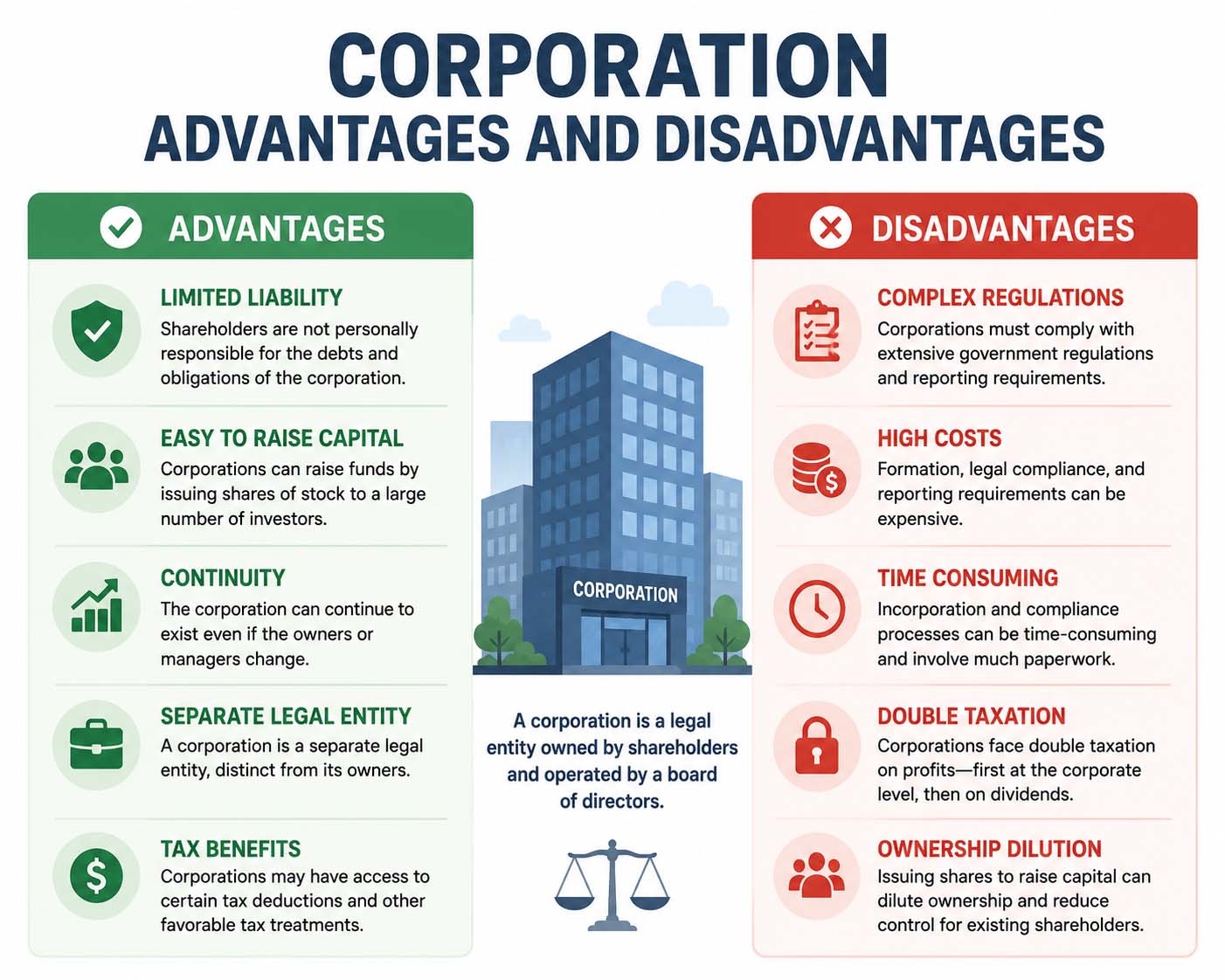
Corporation Advantages and Disadvantages at a Glance
Before looking at each point in detail, here’s a quick comparison.
| Advantages | Disadvantages |
|---|---|
| Limited personal liability | Higher startup costs |
| Easier access to investment | More regulations |
| Perpetual existence | Additional recordkeeping |
| Greater business credibility | Possible double taxation |
| Easier ownership transfer | Formal management structure |
The right choice depends on your business size, funding goals, and future plans.
Major Advantages of a Corporation
Many entrepreneurs choose to incorporate because corporations offer protections and growth opportunities that other business structures may not.
Limited Liability Protection
One of the biggest advantages is limited liability.
Because the corporation is its own legal entity, shareholders are generally not personally responsible for business debts beyond their investment.
This separation helps protect personal assets if the company experiences financial difficulties or legal claims.
Easier Access to Capital
Corporations often find it easier to raise money.
Funding may come from:
- Selling shares
- Private investors
- Venture capital firms
- Institutional investors
This flexibility can support faster growth compared to businesses that rely only on owner contributions or loans.
Perpetual Existence
A corporation doesn’t automatically end when an owner leaves, retires, or passes away.
Ownership can be transferred through stock sales while the business continues operating.
This stability makes corporations attractive for businesses planning long-term expansion.
Enhanced Business Credibility
Many suppliers, customers, and investors view incorporated businesses as more established.
Although success is never guaranteed, incorporation may improve confidence when negotiating contracts or seeking financing.
Ownership Can Be Transferred More Easily
Unlike some business structures, corporate ownership can often be transferred through the sale or transfer of shares.
This makes succession planning much simpler, especially for larger businesses.
Businesses that eventually become part of larger corporate groups sometimes operate within structures similar to Was Ist Eine Holding, where multiple companies exist under one parent organization.
Types of Corporations
Not every corporation follows the same tax or ownership rules.
The two most common forms are C corporations and S corporations.
C Corporation
A C corporation is a separate taxable entity.
It pays corporate income tax, and shareholders may also pay taxes on dividends they receive.
Despite this tax structure, many large companies choose C corporations because they offer flexibility for raising capital and issuing multiple classes of stock.
S Corporation
An S corporation generally allows profits and losses to pass directly to shareholders for tax purposes, avoiding corporate income tax in many cases.
However, eligibility requirements often include limits on:
- Number of shareholders
- Shareholder residency
- Stock classes
Business owners comparing structures frequently research the advantages and disadvantages of s corporation before deciding whether this option fits their needs.
Comparing C Corporations and S Corporations
| Feature | C Corporation | S Corporation |
|---|---|---|
| Corporate Tax | Yes | Usually pass-through |
| Shareholder Limits | None | Yes |
| Stock Classes | Multiple allowed | Generally one class |
| Investor Appeal | High | More limited |
| Ownership Flexibility | Greater | More restrictions |
Choosing between these structures depends on tax planning, investment goals, and ownership plans.
Real-World Example
Imagine a technology startup planning rapid expansion.
The founders expect to attract outside investors within two years.
Because venture capital firms often prefer C corporations, the founders may decide that the advantages and disadvantages of c corporation favor long-term fundraising despite the additional compliance requirements.
On the other hand, a small family-owned consulting business might prefer an S corporation if it qualifies and values pass-through taxation.
Key Responsibilities of Corporate Owners
Running a corporation involves more than filing formation documents.
Owners and directors typically need to:
- Hold regular meetings
- Keep corporate records
- File annual reports
- Maintain financial documentation
- Follow applicable corporate laws
These requirements help preserve the legal separation between the business and its owners.
Corporations Operate Within Competitive Markets
Corporations don’t exist in isolation.
They buy products, sell services, negotiate contracts, and compete with other businesses every day. These activities are part of What Is the Voluntary Exchange of Goods and Services, where buyers and sellers freely agree to transactions that benefit both sides.
Understanding how corporations participate in competitive markets helps explain why legal structure is only one factor behind long-term business success.
Planning Before Incorporating
Before filing incorporation documents, business owners should carefully consider:
- Long-term growth plans
- Funding needs
- Tax implications
- Ownership structure
- Management responsibilities
- Regulatory compliance
Answering these questions early makes it easier to choose the right corporate structure for your goals.
The Main Disadvantages of a Corporation
While corporations provide valuable legal and financial benefits, they also come with responsibilities that may not suit every business.
Understanding the advantages and disadvantages of a corporation means looking at both sides before making a decision.
Higher Formation Costs
Creating a corporation usually costs more than forming a sole proprietorship or partnership.
Expenses may include:
- Registration fees
- Legal assistance
- State filing costs
- Annual reporting fees
The exact amount depends on your location and the type of corporation you choose.
More Administrative Requirements
Corporations must follow more formal procedures than many other business structures.
These responsibilities often include:
- Holding shareholder meetings
- Recording board meeting minutes
- Filing annual reports
- Maintaining corporate records
- Following corporate governance rules
Although these requirements create additional work, they also help maintain transparency and accountability.
Possible Double Taxation
One of the most discussed advantages and disadvantages of corporation structures involves taxation.
With many C corporations:
- The corporation pays income tax.
- Shareholders may also pay taxes on dividends they receive.
This situation is commonly referred to as double taxation.
S corporations may reduce this issue through pass-through taxation if they meet eligibility requirements, although tax rules vary by country and jurisdiction.
Reduced Flexibility
Business owners operating alone can often make decisions immediately.
Corporations typically require approval from directors or shareholders for significant actions, including:
- Mergers
- Major investments
- Ownership changes
- Large financial commitments
This structure improves oversight, but it can slow decision-making.
Common Mistakes When Forming a Corporation
Many new business owners assume incorporation automatically guarantees success.
In reality, the legal structure is only one piece of the puzzle.
Here are some common mistakes to avoid.
Choosing the Wrong Corporate Structure
Some entrepreneurs automatically choose a C corporation without comparing alternatives.
Others select an S corporation without confirming they meet the eligibility requirements.
Reviewing ownership goals, tax considerations, and future investment plans first can prevent expensive changes later.
Ignoring Corporate Formalities
One major benefit of incorporation is liability protection.
However, failing to keep proper records or mixing personal and business finances can weaken that protection.
Good recordkeeping supports both compliance and better business management.
Overlooking Long-Term Growth
The structure you choose today should still support your business several years from now.
If you expect to seek outside investors, expand internationally, or issue shares, those plans should influence your decision from the beginning.
Best Practices for Running a Corporation
Successful corporations usually share several habits.
Keep Accurate Records
Maintain organized records for:
- Financial statements
- Tax filings
- Board resolutions
- Shareholder information
- Corporate policies
Accurate documentation supports compliance and simplifies audits.
Define Leadership Roles Clearly
Every corporation benefits from clearly assigned responsibilities.
Examples include:
- Chief Executive Officer
- Chief Financial Officer
- Operations Manager
- Department Leaders
Defined roles reduce confusion and improve accountability.
Review Business Goals Regularly
As your company grows, revisit your:
- Growth strategy
- Funding needs
- Ownership structure
- Tax planning
- Risk management
Regular reviews help ensure your corporate structure continues supporting your objectives.
When a Corporation Makes Sense
A corporation may be a strong choice if you:
- Plan to raise investment capital.
- Want liability protection.
- Expect long-term growth.
- Need ownership to transfer easily.
- Intend to build a large organization.
Small lifestyle businesses with limited growth goals may find another structure more practical, depending on local laws and tax rules.
Presenting Your Business Professionally
Whether you’re seeking investors or attracting customers, communicating your company’s value clearly matters.
As your business grows, learning What Is the Main Purpose of Developing a Business Pitch can help you explain your products, services, and long-term vision with confidence.
Likewise, corporations involved in financing or investment may regularly work with financial intermediaries. Understanding What Is a Broker provides useful context for businesses that buy or sell securities, insurance products, or other financial services through licensed professionals.
Frequently Asked Questions
What are the biggest corporation advantages and disadvantages?
The biggest advantages include limited liability, easier access to investment, greater credibility, and perpetual existence.
Is a corporation better than an LLC?
Neither structure is automatically better.
The right choice depends on factors such as taxes, ownership plans, funding goals, liability protection, and local regulations.
What is the difference between an S corporation and a C corporation?
An S corporation generally uses pass-through taxation and has ownership restrictions. A C corporation pays corporate income tax but offers greater flexibility for attracting investors and issuing different classes of stock.
Can one person own a corporation?
Yes.
Many jurisdictions allow a single individual to own and manage a corporation while still benefiting from limited liability protections, provided legal requirements are followed.
Do all corporations sell stock publicly?
No.
Many corporations remain privately owned throughout their existence. Publicly traded corporations represent only a portion of all incorporated businesses.
Choose the Structure That Fits Your Long-Term Vision
Understanding corporation advantages and disadvantages allows you to make a business decision based on your goals rather than assumptions. A corporation offers strong liability protection, easier access to capital, and a structure designed for long-term growth. At the same time, it demands greater administrative effort, ongoing compliance, and careful planning.
Before incorporating, evaluate your expected growth, financing needs, tax situation, and management style. Taking time to compare your options today can help you build a business structure that supports your company for years to come.